
When I Found Out This Positive Adjective Was Originally a Comparative, I Was SHOOK
And you won’t BELIEVE what the superlative is!

Look, I’ve been sitting on this one for a while, and I just haven’t quite been able to figure out the right format to tell people about it. Sometimes you can solve this sort of problem at the headline level: “I Was Today Years Old When I Learned This Positive Adjective Used to Be a Comparative.” “My Head Is Spinning About Where This One Weird Adjective Comes From.” “People Are Learning the Origin Story of This Common Word, and I, for One, Am Here for It.” But sometimes it’s better to just get it out before people lose interest. Always it’s better to do this. I’ll just do it.
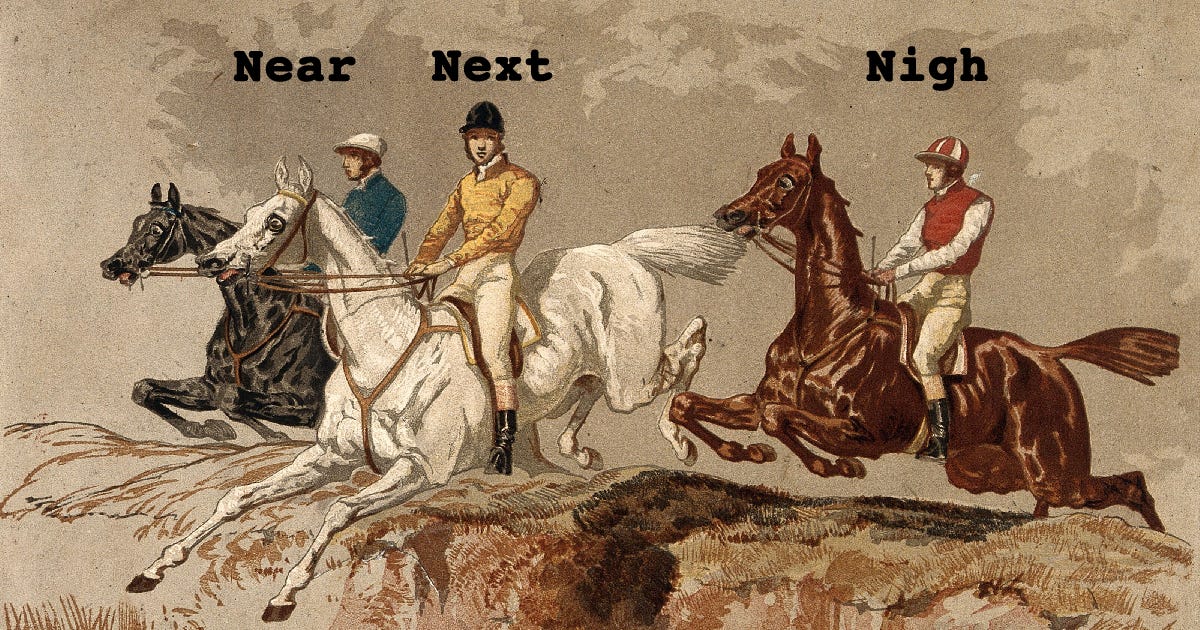
According to “Words and Their Ways in English Speech,” a lovely out-of-print book from 1901 by two Harvard linguists that I’m a little bit obsessed with, the words near and next are …
“really the comparative and superlative of the adjective nigh, but they are no longer associated with nigh in our consciousness. They survive as independent words. Near has become a positive, and a new comparative has been formed from it, – nearer, which really shows a double comparative ending.”
Put more plainly, the word near was originally the comparative form of nigh – nigh-er – and next was its superlative – nigh-est. Nigh, near, next.
Near isn’t the only word that’s been promoted from comparative to positive in this way, though it’s rare to find one that hasn’t been bereaved of its other degrees (nigh and next are still around, even if they’re estranged). Utter (as in “an utter disgrace”) follows the pattern to an extent – it’s still friendly with its superlative, utmost, but has mostly lost touch with its positive, out, which nowadays can be found palling around with outer. The adverb rather is the comparative form of the mostly obsolete rathe, meaning (among other things) “early,” as in Tennyson’s In Memoriam:
Thy converse drew us with delight,
The men of rathe and riper years:
The feeble soul, a haunt of fears,
Forgot his weakness in thy sight.
And the superlative, rathest, is rarer still, though it turns up in a few odd places with the sense “most particularly.” Beatrix Potter uses it in her journals (“I would rathest of all copy the raised plaques of Wedgwood”), and Edna St. Vincent Millay gives it to the character Aelfrida in her 1927 play The King’s Henchman:
Ghent in Flanders! Great town of my many dreams! Why, lo, thou—thither to fare, That would I rathest of all things under the welkin!
“That would I rathest of all things under the welkin” is – with all due respect to the lovely town of Ghent and the great E. St. Vincent Millay – a very silly thing to say.
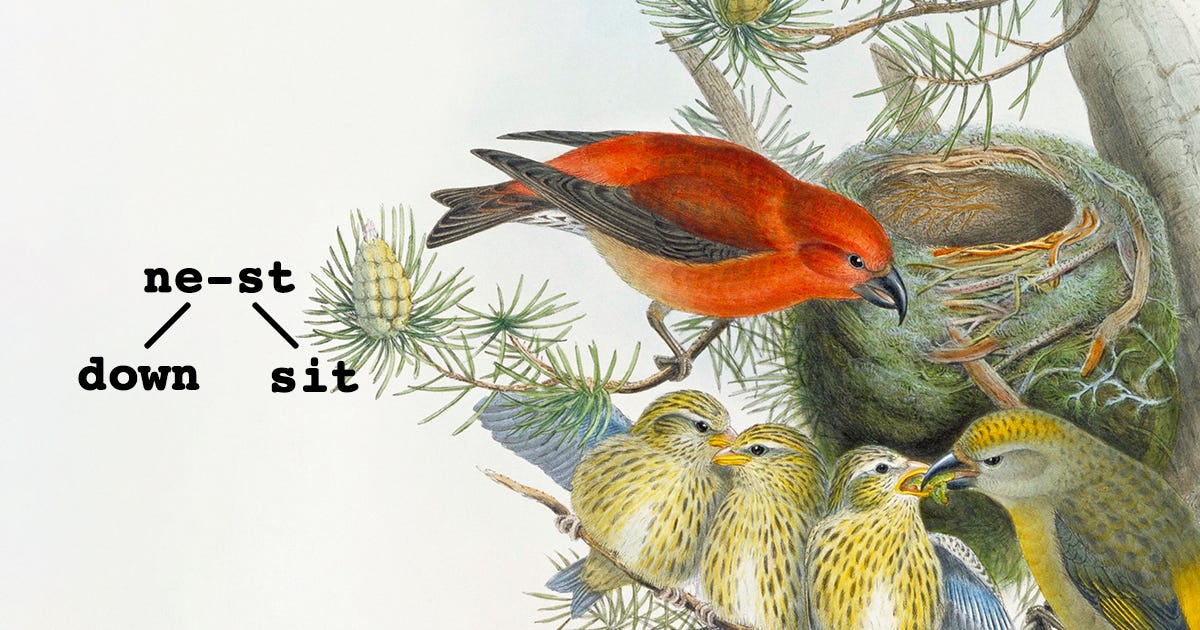
Nether (as in “nether regions”) started life as a comparative of *ni-, meaning “below,” a root that also rather charmingly appears in the word “nest”: The -st in “nest” is from the same word that gives us “sit,” and so “nest” quite literally means “sit down.” Nether lost touch with its own comparative in the 16th century, which is a shame, because nethermore is quite lovely, but we still just about have the superlative, nethermost, as in Joyce’s Ulysses:
The nethermost deck of the first machine jogged forward its flyboard with sllt1 the first batch of quirefolded papers.
Probably the most famous comparative that’s lost touch with its positive is better, which along with its sister best has been adopted into the well-to-do good family. But there was once a bote to go along with better and best, and it’s not quite dead yet. You can still find it in the phrase “to boot,” as in, “He’s handsome, and he’s rich to boot!” or in Shakespeare’s self-referential Sonnet 135:
Whoever hath her wish, thou hast thy Will,
And Will to boot, and Will in overplus;
Well, we’ve strayed a bit further afield from near than I originally intended, and I’m realizing (to boot) that I probably could have done the whole thing with just a headline and saved us all a lot of time: “Nigh Used to Go Before Near. You Won’t Believe What Happened Next.”
The “sllt” is not a typo, FWIW. Joyce has decided that this is the sound a printing press makes, and we are not to question him.
A very nice column!
The delightful, and erudite, BBC program “What’s The
Good Word” taught me that you can’t put your best foot forward unless you have three feet.
I also learned that Still Waters don’t run deep, because still waters don’t run at all.
I believe they’ve archived the program somewhere, and it’s well worth finding.
The fact that "nearer" is technically a double comparative (nigh-er-er) is the kind of etymological absurdity that makes language so fun to dig into.
What strikes me is how these orphaned comparatives reveal old family trees — "to boot" as the last surviving relative of bote/better/best is like finding a linguistic fossil hiding in plain sight.
Also: that punchline about nigh/near/next may be the best etymology joke I've read this year.